The reality is that what got you here can’t get you there. CEOs who have scaled successfully say they wish they had moved faster to throw off the habits, assumptions, and capabilities that created initial success but now impede growth. The time to act is now. The cost of delay always exceeds the cost of action.
"I thought our growth stall was a market problem. Turned out to be a me problem. The org 360 Christine conducted showed me my blind spots."
"I used these frameworks to diagnose real issues and I made specific changes as a result."
"The delegation assessment was uncomfortable in exactly the right way. My team confirmed what I didn't want to admit."
You built something real. Revenue that would have seemed impossible five years ago. A team. A product people actually want. You did that.
And now you're stuck in a way that doesn't make sense.
The meetings are longer. The decisions are slower. The people who were brilliant at $5M are starting to look like a liability at $20M. You already know what needs to change. You've known for a while. But somehow nothing changes fast enough, and you end up in another week of back-to-back calendar blocks with no time to think.
Here's what that internal monologue sounds like:
"I can't take a real vacation without things falling apart. I know we have a leadership problem but I don't want to blow everything up. I'm the bottleneck and I know it. I just don't know how to get out of my own way without losing control of the company I built."
If you recognized yourself in any of that, you're not broken. You're at a predictable inflection point that hits almost every growth-stage company between $5M and $50M. The patterns are almost identical across industries, business models, and founding stories.
The problem isn't that you lack ambition or intelligence or the willingness to work hard. You have all three in abundance, which is exactly why you're here.
The real problem is structural. You are still running a $5M company inside a $20M company. The systems, the habits, the team configuration, and the decision-making approach that created your success are now the same things limiting it. And no one around you can tell you that plainly, because their jobs, their equity, and their relationships are all tangled up in the answer.
The thing standing between you and the next stage isn't out there. It's the assumptions, habits, structures, and loyalties you haven't been willing to examine.
Most CEOs believe that growth slows because of market conditions, competition, or bad luck. That belief is understandable. It's also costing them years.
The research, the case studies, and the pattern across hundreds of scaling companies all point to the same culprit: the CEO. Not because they're doing something wrong. Because they're doing something right that no longer fits.
The thing that made you indispensable at $5M, being close to every decision, knowing every customer, solving every problem faster than anyone else, becomes the structural ceiling at $30M. The loyalty that built a great culture in year two starts to protect underperforming leaders in year seven. The hustle that defined the early days becomes the expectation that everyone works like the founder, which is a great way to burn out your best people.
Nobody tells you this. Not your board, not your leadership team, not your investors. Because the truth requires admitting that the constraints on your growth are not external. They're sitting at the head of the table.
The standard advice for a stuck CEO usually goes one of three ways. Hire a consultant to audit your strategy. Go to a leadership conference. Read the latest book on high-performance culture.
The problem with all three is the same: they address symptoms. They assume the bottleneck is informational, that you just need the right framework or the right vocabulary. Give it twelve weeks and you'll be back in the same patterns because the underlying dynamics, the blind spots, the team mismatches, the delegation gaps, were never surfaced.
The reason those approaches fail is that they can't tell you what your people won't. As your company grows, information gets filtered on its way up to you. Your senior leaders manage what they share. Bad news travels slowly, if at all. The person three levels down who can see exactly what's broken has no way to reach you. And you're moving too fast to notice the gap between what you're being told and what's actually happening.
You can't fix what you can't see. And the higher you climb, the harder it gets to see clearly.
I spent three decades inside growth-stage companies watching how decisions were made and advising senior leaders. I've spent the past seven years leveraging that experience to advise growth-stage CEOs.
What I kept seeing wasn't a strategy problem. It was a pattern problem. The same constraints showing up in companies across different industries, different business models, different founding teams. Revenue plateauing at the same inflection points. Leadership teams that hadn't grown with the company. CEOs who were brilliant and exhausted and quietly wondering if this is just what scaling feels like.
I know what it costs to ignore those signals. I've watched a CEO have a heart attack and then return to the exact same patterns from his hospital bed, micromanaging a GM he had finally hired, undoing the only structural change that might have saved his company and his health. That story stayed with me because it was the clearest version of something I'd seen in less dramatic forms dozens of times.
The wake-up moment, for me, was the same realization every time I walked a CEO through the findings from an honest, unfiltered look at their own organization: the thing standing between you and the next stage isn't out there. It's the assumptions, habits, structures, and loyalties you haven't been willing to examine. Not because you're afraid. Because no one around you has been positioned to tell you the truth.
Becoming unbound isn't a mindset shift. It's a structural one.
Think of it this way. A high-performing athlete at the wrong training program doesn't need more motivation. They need a coach who can see what they can't, name the specific thing that's limiting performance, and build a different plan. The limitation was always structural. Naming it is what makes it fixable.
That's what this book does. It shows you where the bindings are, why they formed, and exactly how to remove them, stage by stage.
A system for identifying and removing the predictable constraints
that emerge as companies scale from $5M to $50M and beyond, across every dimension of a growth-stage company: people, priorities, decisions, structure, culture, capital, and self-disruption.
"I thought our growth stall was a market problem. Turned out to be a me problem. The org 360 Christine conducted showed me my blind spots."
"I used these frameworks to diagnose real issues and I made three specific changes as a result."
"The delegation assessment was uncomfortable in exactly the right way. My team confirmed what I didn't want to admit."
"I used to think getting out of the weeds meant losing control. After making the recommended changes, I actually have more visibility than when I was in every meeting."
"The insights on integrating acquisitions helped us avoid critical mistakes and allowed us to get to the desired returns much more quickly."
"Christine's framework gave me language for problems I'd been feeling for two years but couldn't name. That alone accelerated the decisions I'd been avoiding."
One CEO came to me after three years of revenue stagnation around the $18M mark. He was convinced the problem was his sales function. We conducted an organizational 360, interviewing twenty-three people across every level and function. The themes were consistent and pointed clearly to a different culprit: a leadership team that had stopped developing, a CEO who was compensating by staying close to every decision, and a prioritization approach that had the company in permanent crisis mode.
He spent several months making carefully considered changes. A year later, his words: "Your report was right about everything. Some of it I knew. I didn't realize how many other people saw it too, or how urgent some of the issues had become."
Revenue crossed $27M the following year.

Christine Britton spent three decades advising senior leaders inside growth-stage companies. For the past seven years, she has been leveraging that experience to advise growth-stage CEOs.
What she keeps seeing is that the same constraints show up in companies across different industries, different business models, different founding teams. Revenue plateauing at the same inflection points. Leadership teams that hadn't grown with the company. CEOs who were brilliant and exhausted and quietly wondering if this is just what scaling feels like.
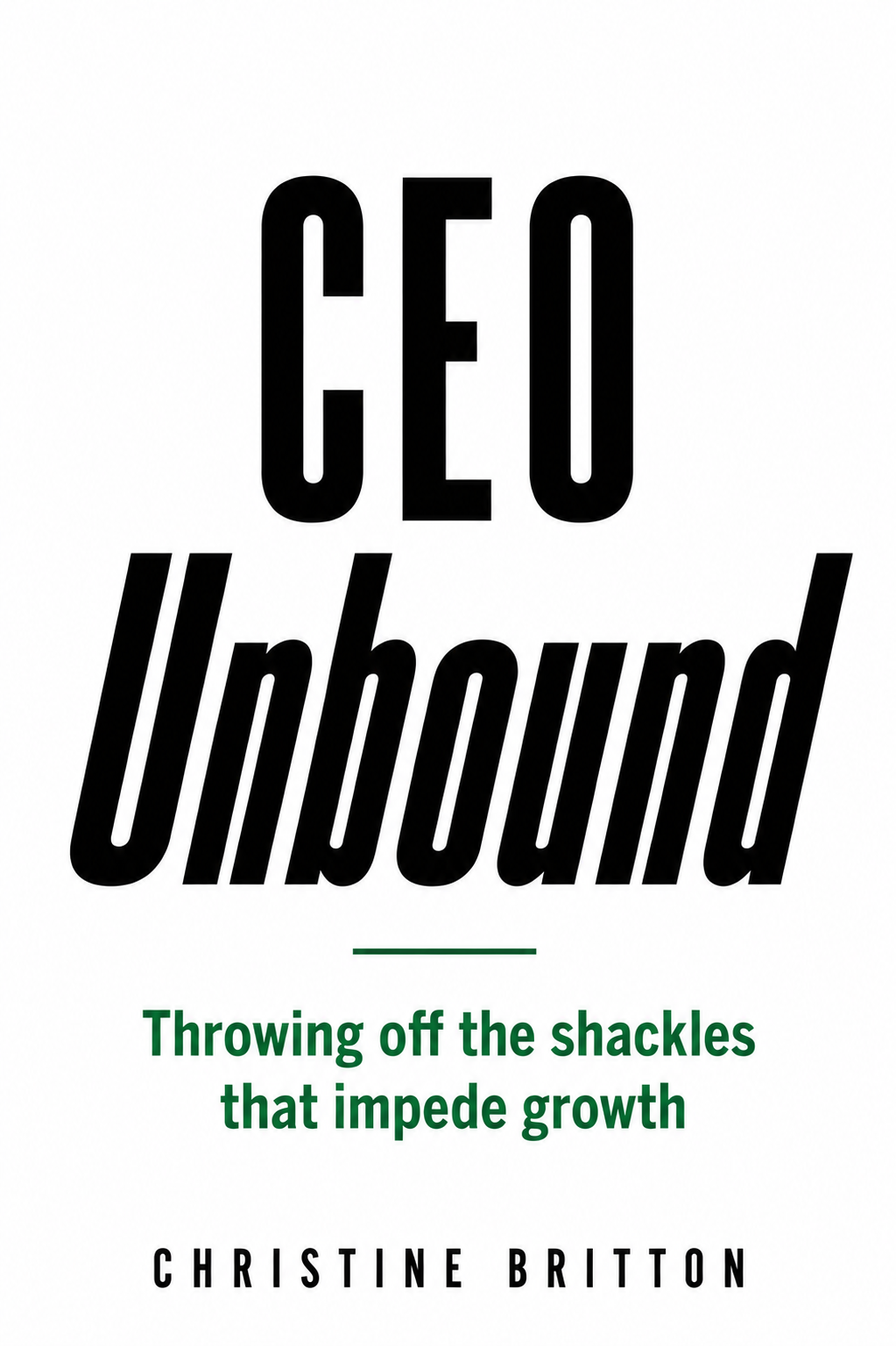
CEO Unbound is the distillation of those observations, and the system she developed for helping CEOs and founders identify and remove the structural constraints standing between them and the next stage of growth.
Get your copy today and start applying it this week.